20 Questions That Reveal What Your Home Inspector Won’t Tell You (And When to Ask Them)
Asking the right questions to ask your home inspector is the single best way to turn a standard walkthrough into real protection for your purchase. Most buyers only show up for the last 30 minutes, nod politely, and leave with a 40-page report they never fully read. Here is exactly what to ask—before, during, and after—so nothing gets missed.
Why Asking the Right Questions to Ask Home Inspector Matters
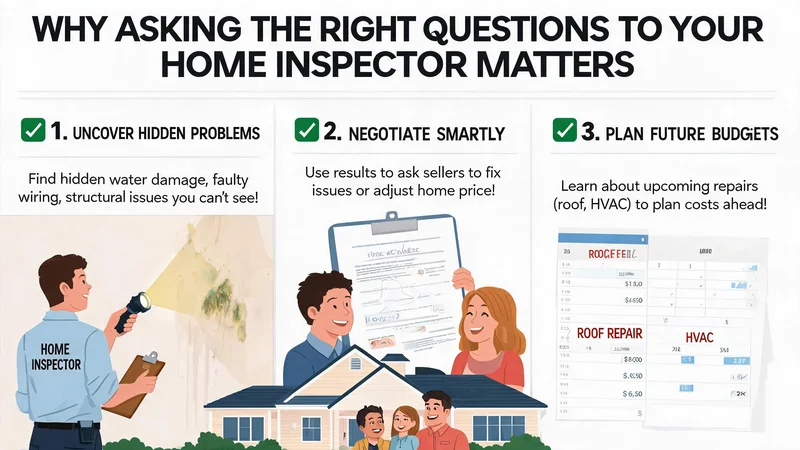
A home inspection is your best chance to uncover costly defects before closing. A furnace that dies in year one or a slow foundation crack can mean real money, but only if you know to ask. The inspector is there to document what they see, but you are the one who gets to ask what those findings actually mean for your wallet and your timeline.
Most buyers only attend the last 30–60 minutes of a 2–3 hour inspection. That is a mistake. Being present the whole time lets you ask the kinds of questions that never make it into the typed summary. You can point at a stain on the ceiling and ask, “What’s behind that?” The report will say “staining observed,” but the inspector standing next to you might say, “That’s an old leak, dry for years—monitor it,” or “That’s active moisture, I’d get a roofer out this week.” Those two answers lead to very different negotiations.
What Should You Ask a Home Inspector Before the Inspection Starts?
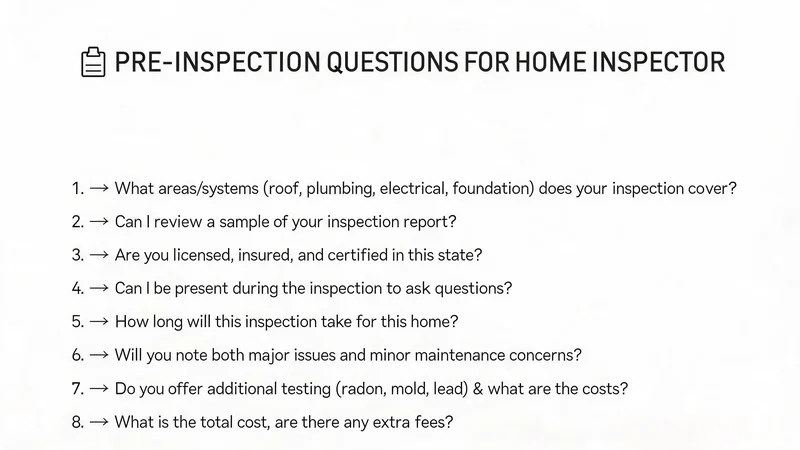
Before the ladder comes out, you need to know who you are dealing with and what they will actually inspect. Ask directly: “Are you licensed in this state, and do you carry errors and omissions insurance?” Licensing rules vary by region, and E&O insurance means you have recourse if a major issue gets missed through negligence.
Then ask, “What does your standard inspection cover, and what does it exclude?” Many inspectors do not check pools, septic systems, radon, mold, or buried oil tanks unless you ask and pay extra. A “whole home” inspection often skips exactly those systems that cost the most to repair. Septic system repair alone can run $2,000–$15,000. Knowing the gaps upfront lets you schedule specialty inspections before your contingency window closes.
What Are the Most Important Home Inspector Questions to Ask During the Walkthrough?
As you follow the inspector from attic to crawlspace, you need a system for sorting what they say. Ask them to point out which issues are safety hazards versus cosmetic concerns. A missing smoke alarm in a bedroom is a safety item for $20–$100. Peeling paint on a baseboard is cosmetic. Both show up on the report, but only one should keep you up at night.
For every defect, ask the same question: “Is this a big deal, a moderate fix, or something to monitor?” That single phrasing gives you a priority list. “Big deal” items go into your repair request. “Moderate fix” items are fine to tackle after closing. “Monitor” items go onto a sticky note on your fridge. You will get honest answers from an inspector who knows you are using this to negotiate, not to nickel-and-dime the seller over a loose outlet cover.
What to Ask Inspector During Home Inspection About Major Systems and Red Flags
Water is the enemy of every house. Ask, “Do you see signs of water damage, foundation cracks, or drainage problems around the property?” Foundation crack repair ranges from $500–$10,000 depending on type. A downspout that dumps water against the foundation wall is a $50–$500 fix today—or a $10,000 structural problem in five years. The inspector will point to grading, gutters, and downspout placement if you ask.
Then ask about the electrical panel. “Is this panel a known fire-risk brand, and is it undersized for modern use?” Older panels from certain manufacturers are well-known fire hazards. Even if the brand is fine, a 60-amp panel cannot handle an EV charger plus central air. Panel replacement runs $1,500–$5,000. Rewiring or outlet work can run $200–$5,000 per job. This is not cosmetic—it is the difference between a safe house and an insurance claim waiting to happen.
Smart Questions to Ask Your Home Inspector After the Inspection Is Over
Once the report is in your inbox, do not just file it away. Ask the inspector, “Which repairs are urgent enough to negotiate with the seller before closing?” A deteriorated firebox with an opening into the throat can cost $500–$2,500 and is a genuine fire hazard. A missing anti-tip bracket on a range costs $100–$300 and prevents a child from pulling the stove over. Those are leverage. A sticky window is not.
Also ask, “Which items can I realistically DIY or defer for the first year?” That question turns a scary report into a one-year plan. A foil dryer duct hose is a $150–$400 fire risk you can replace with rigid pipe in an afternoon. A missing water heater pressure-temperature relief valve extension is $100–$300 and prevents scalding. Paintable stucco cracks and loose deck boards can wait until spring if they are not structural. Your inspector will tell you what is safe to defer and what is not.
Your Inspection Day Checklist: 20 Questions to Ask Home Inspector
Print this list or keep it open on your phone. Write answers as you go.
Before the inspection:
- Are you licensed in this state, and do you carry errors and omissions insurance?
- What does your standard inspection cover, and what does it exclude?
- Will you inspect the roof, crawlspace, attic, and all major systems yourself?
- Do you recommend any additional inspections (radon, mold, sewer scope, septic, pool) given this property’s age and condition?
During the walkthrough:
- Which issues here are safety hazards versus cosmetic concerns?
- For each defect, is this a big deal, a moderate fix, or something to monitor?
- Do you see signs of water damage, foundation cracks, or drainage problems around the property?
- Is the electrical panel a known fire-risk brand, or undersized for modern use?
- How old is the roof, and what is the realistic remaining life?
- Is there any evidence of active leaks, past leaks, or hidden moisture in the crawlspace or walls?
- Are the gutters and downspouts doing their job, or are they dumping water against the foundation?
- Is the HVAC system functioning normally, and when did it last receive maintenance?
- Do you see any structural red flags—sagging floors, sticking doors, or cracks wider than a hairline?
- Are there any code violations or immediate safety concerns I need to fix before moving in?
After the inspection:
- Which repairs are urgent enough to negotiate with the seller before closing?
- Which items can I realistically DIY or defer for the first year of ownership?
- What did you see that worries you most about this house?
- What routine maintenance should I plan for in the next 6–12 months?
- If you were buying this house for your own family, what would you fix first?
- Can I share your report with a contractor for ballpark quotes, and will you clarify anything over the phone if needed?
FAQ
What questions should I ask a home inspector before hiring them?
Ask about state licensing, errors and omissions insurance, years of experience, whether they climb the roof or inspect from the ground, and what they exclude from the standard inspection. Also ask how long the inspection takes and whether you can attend the full walkthrough.
Should I attend the home inspection as a buyer?
Yes. Attend the entire inspection, not just the summary. You will hear tone, context, and off-the-record impressions that a written report cannot deliver. It also lets you ask follow-up questions in real time.
How long does a home inspection take?
Most inspections run 2–3 hours for a typical single-family home. Larger or older houses can take longer. Specialty inspections—radon, mold, sewer scope—happen separately and add time to your contingency window.
What is not included in a standard home inspection?
Standard inspections typically exclude pools, septic systems, radon, mold, buried oil tanks, private wells, and sometimes outbuildings. Cosmetic issues like paint, carpet, and small cracks are noted but not deeply evaluated.
Can a home inspector tell me if I should buy the house?
No. A licensed inspector reports on condition and points out defects. They cannot legally or ethically advise you on whether the price is right or whether to walk away. Use their findings to make your own decision with your agent.
What red flags should I look for during a home inspection?
Watch for active water intrusion in the crawlspace or attic, horizontal foundation cracks, electrical panels with overheating signs, missing fire-blocking in the garage, and any roof structure that appears deflected or sagging. Ask the inspector to point out anything they would fix before moving in.
Feeling overwhelmed by your inspection report?
Upload your PDF and get a plain-English breakdown: top issues, severity, estimated repair costs, and next steps.
Analyze my report