
How Much Does a Home Inspection Cost in 2026? A Buyer’s Guide
A standard home inspection on a single-family house in 2026 typically runs $300 to $600, with most buyers paying somewhere between $400 and $500. The exact number depends on your home’s size, age, location, and which add-on services you choose.
What Is the Average Home Inspection Cost in 2026?
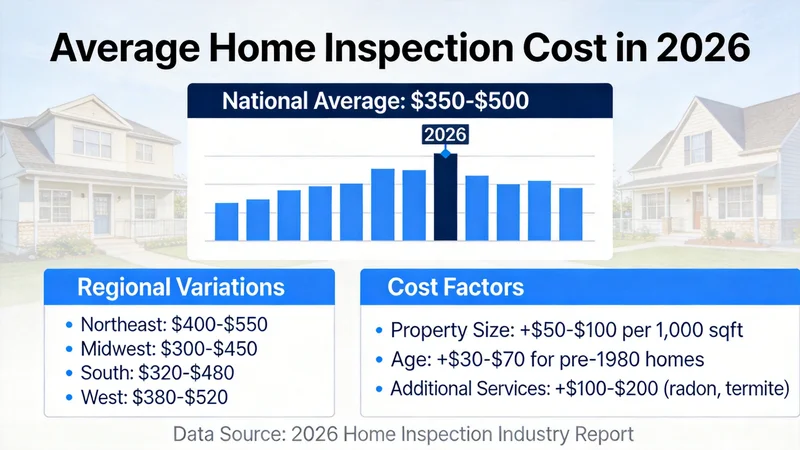
For a typical 1,500 to 2,500 square foot home, expect a base inspection fee in the $400–$500 range. Smaller condos or townhomes can dip closer to $300, while larger properties, especially those over 3,000 square feet, land at $600 or more.
Older homes cost more to inspect because there’s simply more to look at. A 1920s bungalow with a crawlspace, original wiring, and a 30-year-old roof takes much longer to evaluate than a 2015 build. Add-ons like radon testing, sewer scope, or termite inspection each add $100 to $300 to your total.
How Much Does a Home Inspection Cost Compared to Other Home Buying Costs?
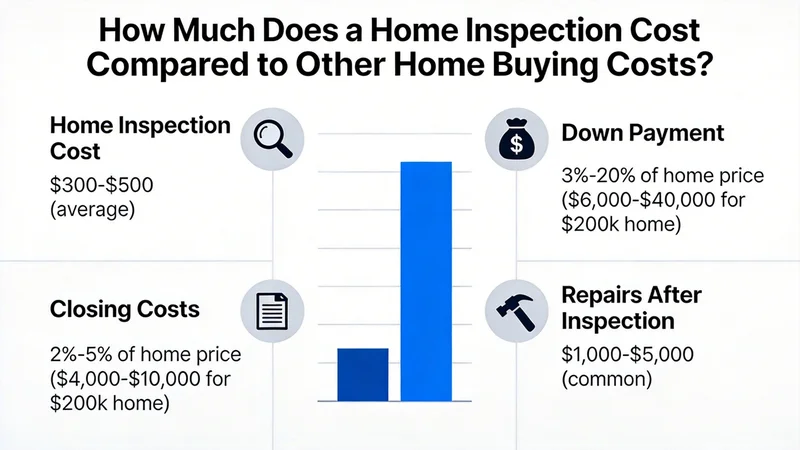
Your inspection fee is one of the smallest line items in the entire transaction. Closing costs alone typically run 2% to 5% of your loan amount. On a $350,000 mortgage, that’s $7,000 to $17,500 before you even think about your down payment.
Sinking $450 into an inspection feels like real money, especially in the middle of a purchase when every wire transfer and fee notice hits your inbox. But that $450 gives you a professional’s eyes inside the largest purchase you’ll likely ever make.
What Factors Affect Your Home Inspection Fee?
Home size is the biggest driver. Inspectors spend two to four hours on-site, and larger homes simply take longer. Age matters too. A 50-year-old house has more wear, more potential problems, and more systems to evaluate than a five-year-old one.
Geography plays a role. Inspection fees in high-cost metros like San Francisco, Boston, or Seattle skew higher than in smaller markets. And specialty inspections push your total up fast. Radon testing runs $100 to $200 in most areas. Sewer scope another $150 to $300. Termite inspection often $75 to $150. Mold testing can hit $300 or more if lab work is involved.
Is a Home Inspection Worth the Money?
Think of the inspection as a crystal ball for your first five years of ownership. A deteriorating roof might look fine from the street, but an inspector who gets into the attic can see stained sheathing, missing flashing, or worn shingles. That roof replacement you didn’t budget for costs $8,000 to $25,000.
Water heater nearing end of life? $1,200 to $3,500. Foundation crack that’s actively leaking? $500 to $10,000 depending on severity. A $450 inspection that catches a $4,000 electrical panel replacement is a 10x return before you even close.
Who Pays for the Home Inspection — Buyer or Seller?
The buyer almost always pays for the inspection. It’s part of due diligence and you want the inspector working for you, not the seller. You choose the inspector, you pay the fee, and you own the report.
Some sellers in competitive markets offer a pre-listing inspection to show good faith. Others may credit you at closing if the inspection reveals defects. But budget for the inspection as your cost.
How Can You Budget for Inspection Costs Before Closing?
Set aside $500 to $800 to cover the base inspection plus one or two add-ons. If you’re buying an older home with a well and septic, bump that to $900 or more. Ask your inspector for a flat-rate quote before booking so there are no surprises.
Pay the inspector directly, ideally with a credit card or check so you have a receipt. Some inspectors offer a small discount for bundling services like radon testing with the base inspection. Ask before scheduling.
FAQ
How much does a home inspection cost in 2026?
Most buyers pay $300 to $600 for a standard single-family home inspection. The typical price falls between $400 and $500. Larger homes, older homes, and add-ons like sewer scope or radon testing raise the fee.
What is included in a standard home inspection?
A standard inspection covers the roof, foundation, structure, electrical panel, plumbing, HVAC, water heater, windows, doors, insulation, and visible interior surfaces. The inspector looks for safety hazards, major defects, and systems near the end of their life. It does not include invasive testing like opening walls or running new wiring.
How long does a home inspection take?
Plan for two to four hours on-site, depending on home size and condition. You should attend if possible. Walking through with the inspector lets you ask questions and see issues in person. The written report usually arrives within 24 to 48 hours.
Is a home inspection required to buy a house?
No, a home inspection is not legally required. But your lender may require a termite or pest inspection in some states. And waiving the inspection to make an offer more competitive is one of the riskiest moves a buyer can make. Without one, you inherit every problem the house has.
Can I negotiate the home inspection fee?
Sometimes. If you bundle multiple services — radon testing, sewer scope, termite — some inspectors offer a small discount. Get flat-rate quotes from two or three inspectors in your area and compare. Do not choose an inspector solely on price.
What happens if the home inspection finds major problems?
You have options. You can ask the seller to make repairs before closing. You can ask for a price reduction or a seller credit at closing to cover the cost of fixing it yourself. Or if the problems are severe — foundation failure, structural rot, failed septic — you can walk away entirely, assuming your purchase agreement includes an inspection contingency.
Making Sense of Your Inspection Report
Reading an inspection report as a first-time buyer can feel like drinking from a fire hose. One report might list a deteriorated firebox opening priced at $500 to $2,500, missing roof tiles at $300 to $1,500, and a water leak at a bathtub connection in the crawlspace at $300 to $1,500.
None of those are deal-breakers on their own. Some are easy DIY fixes. Some are worth negotiating over. Some signal bigger problems hiding behind the drywall. Knowing which is which takes experience.
Not sure how your findings stack up? Many buyers upload their inspection PDF to a plain-English analyzer to get severity, cost ranges, and next steps in minutes.
Feeling overwhelmed by your inspection report?
Upload your PDF and get a plain-English breakdown: top issues, severity, estimated repair costs, and next steps.
Analyze my report